
26.08.13 Global Citizens Expo Process and Responsibilities
Learn → Apply Locally → Reflect & Share → Improve → Demonstrate Globally

A. Overview
The Quarterly Bootcamps provide Ambassadors with an opportunity to demonstrate their mindset evolution, capability development, and leadership growth through real-world application.
The Weekly EXPOs serve as the Ambassadors’ training grounds—a space to practise, refine, challenge, and receive feedback on the skills and mindsets they are developing.
The Regional Weekly Initiatives, led by the Global Citizen Clubs (GCCs), take this learning beyond the EXPO. Ambassadors apply what they have learned within their local context and cohort, testing their understanding through real action, adapting to challenges, and strengthening their capabilities.
The experiences and outcomes from these initiatives are then brought back into the next EXPO. Ambassadors reflect on what happened, share their learning, learn from other regions, and use feedback to improve their next cycle of action.
The Quarterly Bootcamp is the culmination of this continuous development cycle. It provides a platform for Ambassadors to demonstrate their mindset evolution, capabilities, leadership, and real-world impact to an international community.
B. Roles
Participants & Roles
The programme follows a clear progression from regional participation → Ambassador training → session leadership → Bootcamp leadership. Each role contributes to the development cycle.
1. Participants
Members of local cohorts who take part in Regional Initiatives organised by the GCC.
Role: Participate, contribute, and engage in local initiatives.
2. Ambassadors
Members who receive structured training through the Weekly EXPOs and apply their learning through Regional Initiatives.
Role: Learn → Apply → Reflect → Grow.
3. Session Leaders
Ambassadors responsible for preparing and hosting the Weekly EXPO.
Role: Prepare, facilitate, and take ownership of the weekly session.
4. Sub-Leads
Leaders responsible for guiding their respective cohorts during Regional Initiatives, where applicable.
They coordinate participation, ensure members complete assigned activities and submissions, and support the application of EXPO learning.
Role: Lead the cohort and ensure local execution.
5. Bootcamp Commanders
Ambassadors selected to lead and coordinate the Quarterly Bootcamps.
Role: Lead the Bootcamp and demonstrate advanced leadership capabilities.
6. GCC Leads & Co-Leads
Regional leaders responsible for organising and overseeing Regional Initiatives, monitoring progress, and maintaining quality across cohorts.
Role: Lead the regional ecosystem and connect local action with the EXPO.
7. Mentors
Support the learning and development of Ambassadors through facilitation, coaching, and feedback.
Role: Coach, facilitate, and guide development.
3. The Development Cycle
Regional Initiatives → Weekly EXPO → Practice & Reflection → Quarterly Bootcamp → International Showcase
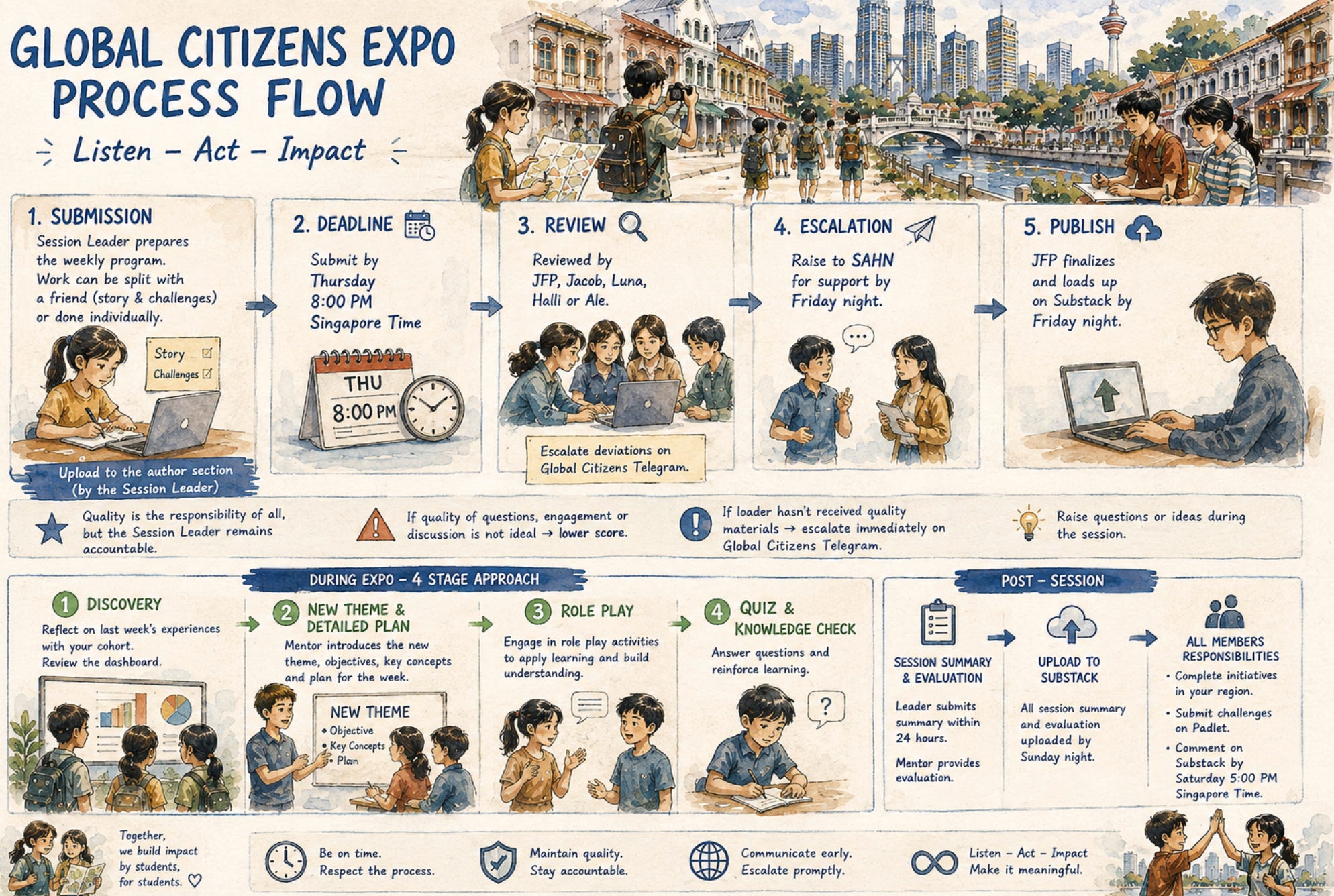
1. EXPO Preparation & Submission
Each EXPO begins with the preparation and submission of the weekly programme by the designated Session Leader.
The Session Leader may:
Collaborate with another Ambassador, dividing responsibilities between story development and challenge creation;
or
Take full responsibility for developing the session independently.
The Session Leader is responsible for ensuring that the complete session package is prepared, uploaded, and ready for review.
Submission Deadline
All weekly session materials must be uploaded to the designated content area by:
Thursday, 8:00 PM Singapore Time
The submission should contain all materials required to facilitate the session, including the story, challenges, discussion questions, engagement activities, and any supporting resources.
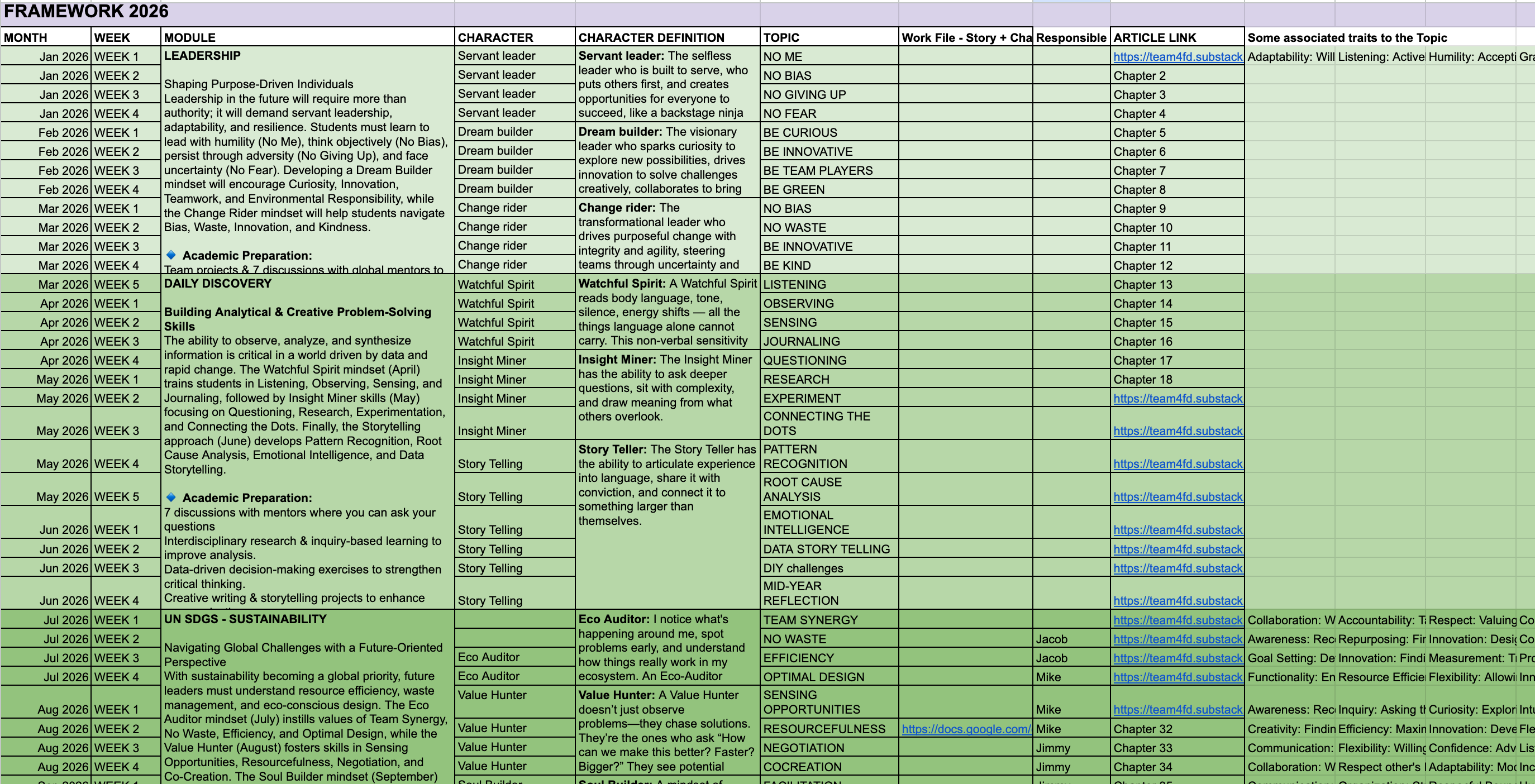
Designated Content area AKA “the Knowledge base”
2. Quality Review & Finalisation
Submitted materials will be reviewed by the designated reviewers: JFP, Jacob, Luna, Halli, or Ale.
The purpose of the review is to ensure that each EXPO session meets the expected standards for:
Content quality
Relevance to the weekly theme
Quality of questions and challenges
Participant engagement
Clarity of instructions
Alignment with the overall Ambassador development journey
Any concerns, quality issues, or deviations from the expected standards should be raised in the Global Citizens Telegram group.
Where additional support is required, the matter should be escalated to SAHN by Friday evening 8 PM Singapore Time. JFP will then complete the final review and publish the materials.
Accountability
Quality is a shared responsibility, but the Session Leader remains accountable for the overall quality of the session.
If the content, questions, activities, or discussion do not meet the expected standard, this will be reflected in the session evaluation.
The same principle applies to the content-loading process. If the designated content loader has not received complete and quality-assured materials by the deadline, they should immediately raise the issue in the Global Citizens Telegram group rather than allowing the delay to continue.
Questions, uncertainties, and new ideas that emerge during preparation should be brought into the weekly coordination session so that the team can align, solve problems collectively, and continuously improve the EXPO.
3. EXPO Session Structure
Each EXPO is facilitated through a four-stage learning cycle designed to connect reflection, preparation, practice, and assessment. You can read more on the link belwo

01 — Discovery
Ambassadors begin by reflecting on their experiences from the previous week.
They share what happened when they delivered the previous session within their respective cohorts, including:
What worked
What did not work
Challenges encountered
Lessons learned
Evidence of participant engagement
Opportunities for improvement
The cohort dashboard and key performance indicators are also reviewed to connect individual experiences with measurable progress.
02 — New Theme & Detailed Plan
The mentor introduces the new weekly theme, including:
Learning objectives
Key concepts
Expected mindsets and capabilities
Story or context
Implementation approach
Regional initiative for the coming week
Ambassadors leave this stage with a clear understanding of what they are learning, why it matters, and how they will apply it.
03 — Role Play
Ambassadors practise the new concepts through role play and simulation.
This allows them to test how they will communicate, facilitate, respond to challenges, and apply the week’s concepts before taking them into their own cohorts.
The EXPO therefore becomes a safe environment to practise before entering the real-world environment.
04 — Quiz & Knowledge Check
The session concludes with discussion questions and a knowledge check designed to reinforce the week’s learning and assess understanding.
The Session Leader consolidates the questions, facilitates the final discussion, and summarises the key learning points.
4. From EXPO to Regional Action
The EXPO does not end when the session ends.
Following each EXPO, Ambassadors return to their respective regions and put the learning into practice.
Each member is expected to complete the initiative assigned to their region and document their experience.
This is where the EXPO learning is tested against reality.
Learn → Apply → Experience → Reflect → Improve
All challenge submissions must be uploaded to Padlet so they can be reviewed, evaluated, and shared across regions. All members are also required to complete the “How Do You Feel?” submission as part of their attendance, reflection, and journal process.
The Sub-Leads of each respective cohort if identified are responsible for ensuring that all members complete these requirements during the Regional Initiatives and that submissions are completed accurately and on time.
5. Post-EXPO Requirements
Within 24 hours after the EXPO, the Session Leader must submit a session summary.
The mentor will then provide an evaluation and feedback report.
All relevant documentation, including session summaries and evaluations, must be uploaded to Substack by Sunday night.
In addition, all members are expected to contribute comments and reflections to the relevant Substack article by:
Saturday, 5:00 PM Singapore Time
6. 360° Evaluation & Continuous Feedback
The EXPO development cycle is supported by continuous evaluation rather than a single end-point assessment.
The Global Citizen Club Leads monitor the quality and development of weekly sessions through multiple sources of evidence, including:
Journals & Reflection
Ambassadors’ journals are reviewed for the quality of reflection, depth of learning, and evidence of mindset development.
Peer evaluation is also incorporated through a 360° feedback process, allowing Ambassadors to learn not only from mentors but also from their peers.
Regional Challenges
Challenge submissions are evaluated by multiple levels of leadership, including:
Bootcamp Commanders
Sub-Leads of smaller cohorts
GCC Leads and Co-Leads
Evaluators provide comments and feedback to help Ambassadors understand both their strengths and areas for development.
Cross-Regional Feedback
Ambassadors from other regions also participate in the feedback process by reviewing, commenting on, and engaging with challenge submissions.
This creates an environment where learning is not limited to one cohort or one region. Ambassadors are continuously exposed to different approaches, perspectives, and solutions from across the Global Citizen community.
7. The EXPO as a Continuous Development System
The EXPO is therefore more than a weekly training session. It is a development system that connects global learning with local action.
Every week, Ambassadors move through a continuous cycle:
Global Learning → EXPO Practice → Local Application → Evidence & Reflection → Peer Feedback → Improvement → New EXPO
Over time, these cycles accumulate into measurable mindset evolution, capability development, and leadership growth—which are ultimately demonstrated through the Quarterly Bootcamp and international showcase.
The EXPO is where Ambassadors caliberate.
The Regional Initiative is where they practise.
The Quarterly Bootcamp is where they demonstrate.
8. Monthly GCC Review & Mindset Calibration
Every month, the Global Citizen Club (GCC) comes together to review the macro-level behavioural and mindset changes emerging across the Ambassador community.
The monthly review provides an opportunity to:
Identify significant behavioural and mindset shifts.
Review progress against the expected development outcomes.
Identify recurring gaps, challenges, or areas requiring deeper attention.
Share observations and evidence across regions.
Calibrate expectations and evaluation standards across GCCs.
Determine any necessary upgrades or adjustments to the training, initiatives, and EXPO process.
This creates a higher-level feedback loop, ensuring that insights gathered from weekly EXPOs, regional initiatives, journals, challenges, and 360° feedback are not only used to evaluate individual Ambassadors, but also to continuously improve the overall development system.
D. Conclusion
The EXPO is designed as a continuous development ecosystem, connecting structured training with real-world action, reflection, feedback, and leadership opportunities.
Through this cycle, Ambassadors do not simply learn—they practise, apply, receive feedback, adapt, and grow. The Regional Initiatives provide the testing ground, the EXPO provides the space to calibrate, and the Quarterly Bootcamp provides the platform to demonstrate that growth.
Ultimately, the system creates a clear pathway from participation to capability, from capability to leadership, and from leadership to measurable impact.
This chapter is pretty good when talking about journals, challenges and 360 feedbacks. When evaluating, these stuff helps us focus on reflections and continuously improve the overall development. Thank you the authors to write such a great article.
This article is very informative and inspiring because it explains how the Quarterly Bootcamps, Weekly EXPOs, and Regional Initiatives help ambassadors develop their skills and leadership. I learned that growth comes from learning, applying, reflecting, and improving. The program also teaches the importance of teamwork, responsibility, and taking action in real situations.