

Chapter 21 - PATTERN RECOGNITION
ELF001- SESSIONS SUMMARY
JFP - Material (STORY & CHALLENGES)

The Language Beneath Everything….
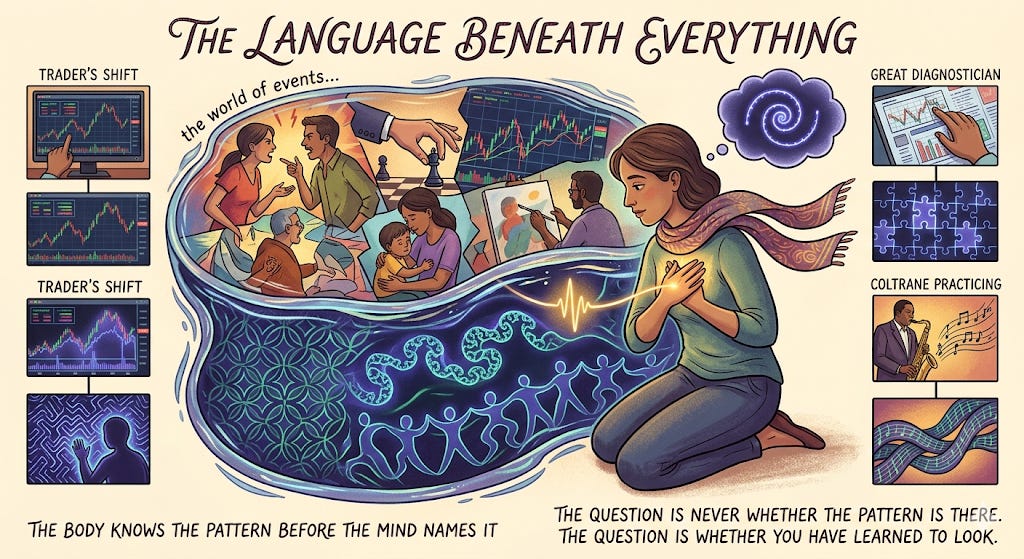
The world is not made of events.
It is made of patterns.
Events are just where patterns surface long enough for us to notice them.
Most people experience life as a series of isolated moments — a conversation that went wrong, a decision that didn’t land, a relationship that quietly fell apart.
What they rarely see is the shape underneath.
The repeating structure. The same dynamic wearing different clothes. The signal that was there all along.
This is what pattern recognition actually is.
Not a skill reserved for mathematicians or detectives. But the most human ability of all — the capacity to feel that something is familiar before you can explain why.
There is a moment every experienced trader knows.
Before the data confirms it. Before the news breaks. Before anyone else has said a word.
Something shifts.
The market feels different.
That feeling is not mysticism. It is pattern recognition operating beneath the threshold of conscious thought — years of observation compressed into a single, wordless signal.
The body knows the pattern before the mind names it.
This is also what great diagnosticians do.
What skilled negotiators do. What the best coaches, editors, investors, and parents do.
They are not smarter than everyone else.
They have simply learned to read what others have stopped looking at.
They notice:
What is conspicuously absent. What keeps recurring despite different explanations. What changes in the room the moment a certain topic is raised. What the data says and what the data is actually showing.
The pattern is always there. The question is whether anyone is paying close enough attention to see it.
But here is what most people get wrong about patterns.
They assume patterns are comfortable. Predictable. Safe.
In reality, the most important patterns are the ones we resist seeing —
because they implicate us, because they require us to change something, because they make the comfortable story harder to tell.
The pattern that keeps appearing in your relationships. The recurring dynamic in every team you’ve ever led. The moment you always hesitate, just before the thing that matters most.
Real pattern recognition is not just intellectual.
It is an act of honesty.
The world rewards speed. It worships novelty. It mistakes complexity for depth.
But underneath every meaningful breakthrough — in science, in art, in human understanding — is someone who was willing to look at the same thing long enough to see what everyone else had stopped noticing.
Darwin spent years watching finches. Coltrane practiced the same scales until they became something no one had heard before. Sherlock Holmes solved crimes not with superior intelligence, but with a refusal to assume he already knew what he was looking at.
The pattern was never hidden.
It was simply waiting for someone willing to be still enough to see it.
This is the work.
Not to acquire more information. Not to think faster.
But to develop the quality of attention that allows patterns to reveal themselves —
in a conversation, in a market, in a piece of music, in yourself.
To notice what repeats. To ask what the repetition means. To sit with the answer long enough to know what to do with it.
Because beneath every problem that seems impossible to solve is a pattern that has not yet been recognised.
And beneath every person who seems impossible to understand is a structure —
a history, a wound, a way of seeing —
that, once seen, makes everything suddenly, quietly legible.
The world does not become simpler when you learn to read its patterns.
It becomes richer.
More layered. More alive.
And far more interesting than you ever thought it was when you were only watching the surface.
The question is never whether the pattern is there.
The question is whether you have learned to look.
Story by JFP| Challenges by MIHF
A. THE PASSAGE
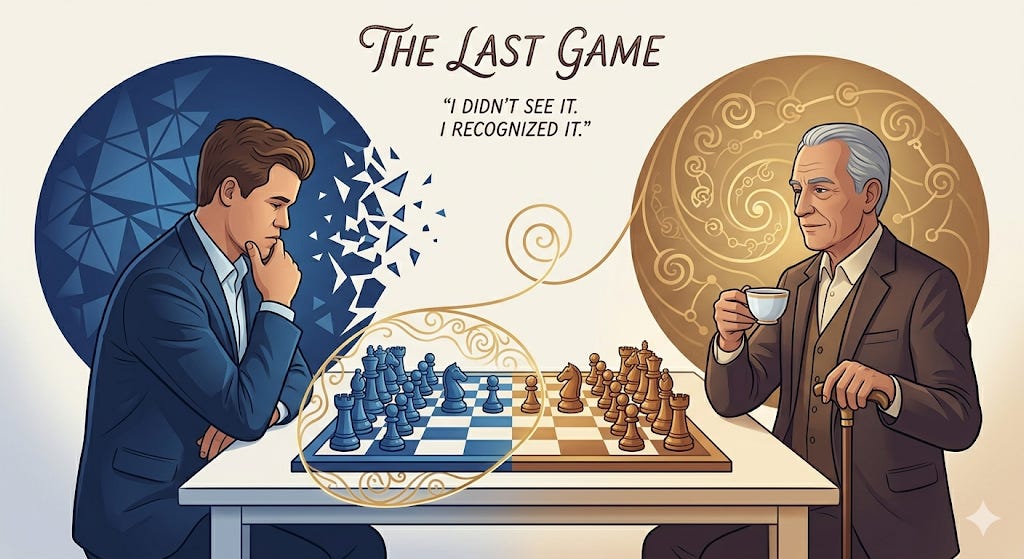
THE LAST GAME
The match was scheduled for two hours.
It lasted six.
By the time Magnus sat down across from the old man, three hundred people had packed into the hall and another forty thousand were watching online.
Nobody came for the chess.
They came because this was supposed to be impossible.
Yuri Demidov was seventy-one years old.
He had not competed in twenty-three years.
His hands shook slightly when he poured his tea. His eyesight had narrowed to a corridor. He walked with a cane he pretended not to need.
Magnus was thirty-four. World champion for nine consecutive years. Unbeaten in classical play for two seasons. A man who processed chess positions the way ordinary people processed breathing — automatically, completely, without apparent effort.
The commentators were kind about it.
“A historic occasion,” they said.
What they meant was: this will be over quickly.
Magnus played the way he always played.
Controlled. Precise. Suffocating.
He didn’t look for brilliant moves. He looked for patterns — positions that restricted his opponent so gradually, so quietly, that the loss arrived before the other player understood they were already losing.
It had worked against everyone.
Grandmasters. Prodigies. Computers built specifically to defeat him.
By move fourteen, the commentators were nodding.
By move twenty, the crowd had grown quiet in the way crowds grow quiet when they sense something ending.
Then Yuri did something strange.
He stopped.
Not to think. Not to calculate.
He simply sat back, folded his hands in his lap, and looked at the board the way you look at a painting — slowly, from a distance, without urgency.
Then he moved a pawn.
One square forward.
The commentators frowned. The engines disagreed. The move seemed to accomplish nothing.
Magnus looked at it for four seconds — which, for Magnus, was a long time — and continued his plan.
Three moves later, Yuri moved another pawn.
Then another.
Quiet moves. Modest moves. Moves that looked like nothing.
But slowly, almost imperceptibly, something was changing on the board.
Space was shifting. Lines were closing. The position Magnus had been building — the suffocating, inevitable position — was becoming something else entirely.
It was becoming Yuri’s position.
At move thirty-one, Magnus stopped.
He leaned forward.
He stared at the board for eleven minutes.
The hall was completely silent.
Because everyone watching — even those who barely understood chess — could feel that something had happened. That the nature of the game had quietly, irrevocably changed without anyone being able to say exactly when.
The commentators pulled up the engine.
The engine was confused.
“He’s seen this before,” the older commentator said quietly.
“Seen what?” his colleague asked.
“Whatever Magnus is trying to do. Yuri has seen this exact pattern before. Not this position — this architecture. He recognized where it was going twenty moves ago.”
He paused.
“He’s been building the counter since move twelve.”
This was Yuri’s gift.
Not calculation. Magnus calculated faster. Not creativity. The young players were more daring.
Pattern recognition so deep it had become something else entirely.
Something closer to memory than thought.
Yuri had played chess for sixty-three years. He had sat across from hundreds of brilliant minds and watched them build their traps and execute their plans. And somewhere inside all of that accumulated watching — beneath the conscious mind, beneath language — he had learned to feel the shape of a game.
Not where it was.
Where it was going.
By move forty, Magnus was in trouble.
Real trouble.
The kind that comes not from a single mistake but from the gradual realization that every correct move you made was part of someone else’s design.
He had played perfectly.
And walked directly into it.
The crowd was no longer quiet.
They were leaning forward in their chairs, standing against the walls, watching something that had no right to be happening.
Yuri sat very still.
He drank his tea.
He did not look triumphant. He did not look tense.
He looked like a man reading a book he had read before — following the sentences with quiet, patient recognition, already knowing how it ends.
Magnus fought.
God, he fought.
For two more hours he fought — finding combinations nobody else in the room would have found, escaping positions that should have been inescapable, refusing to accept what the board was telling him with a ferocity that made the crowd fall in love with him all over again.
But the pattern held.
Every escape route Yuri had already seen. Every combination Yuri had already counted. Every hope Magnus constructed, Yuri had already quietly, invisibly dismantled — fifteen moves earlier, with a pawn nobody noticed.
At move seventy-four, Magnus tipped his king.
The hall erupted.
Yuri sat very still.
He looked at the board for a long moment — not at the final position, but at the whole game, the entire shape of it, the sixty-two moves of invisible architecture that had led here.
Then he looked up at Magnus.
“You played beautifully,” the old man said.
Magnus nodded slowly.
“Where did you see it?” he asked. “When did you know?”
Yuri considered this.
“I didn’t see it,” he said finally. “I recognized it.”
He picked up his cane.
“There is a difference.”
That night, alone in his hotel room, Magnus replayed the game.
Move by move. Hour by hour.
He wasn’t looking for his mistake.
He was looking for the moment — the exact moment — when Yuri had understood what Magnus was building and had begun, quietly, to construct its undoing.
He found it at move twelve.
A pawn.
One square forward.
Doing nothing. Meaning everything.
This is what pattern recognition looks like at its furthest edge.
Not seeing what is there.
Seeing what is coming.
Reading the present so deeply that the future becomes legible — not as prediction, but as recognition.
The pattern was never hidden.
It simply required someone who had looked at enough games, lived through enough positions, sat with enough failures and near-misses and hard-won understandings —
to feel the shape of it before anyone else could see it.
Yuri Demidov died fourteen months later.
Quietly. At home.
Magnus was asked to speak at the memorial.
He stood at the podium for a moment without speaking.
Then he said:
“He taught me that the most dangerous move on a chess board is not the brilliant one. It is the quiet one. The one that looks like nothing. The one that is already three moves ahead of where you think the game is.”
He paused.
“I have been thinking about that ever since. Not just in chess.”
The pattern is always already there.
The only question is whether you have seen enough —
to recognize it before it is too late.
JOIN US THIS WEEK @ THE EXPO and let’s discuss your academic notes on this exciting review ZOOM ID : 769 712 5558 (click ZOOM for the link or use the ZOOM ID)
PASS CODE : MEET
8:30 PM - 9:30 PM SINGAPORE TIME
7:30 PM - 8:30 PM VIETNAMESE TIME
6:00 PM - 7:00 PM INDIAN STANDARD TIME
4:30 PM - 5:30 PM OMAN TIME
The agenda this week
score board - Self reflection for AMBASSADORS : the quality of the program is determined by the filling up of the document and self reflection and responses to feedback already provided.
challenges for the week
practical use of school knowledge.
A New chapter 22- awaits REMINDER ON THE DATES
Week of Chapter 22 - ROOT CAUSE ANALYSIS
BLCOP- SESSIONS SUMMARY
ALL MEMBERS - READ EVALUATION AND COMMENT
MATERIAL - JFP
B. PATTERN RECOGNITION

Reflection – Taking time to think deeply about your thoughts, emotions, and experiences so you can understand yourself and your situation better.
Observation: Noticing trends and similarities
Attention to Detail – Noticing small signs, behaviours, and changes around you that others may overlook, and understanding their importance.
Critical Thinking – Looking beyond the surface and questioning why things are happening instead of simply accepting them.
Consistency – Building the habit of journaling regularly, even on ordinary days, so reflection becomes a natural part of growth.
Comparison: Evaluating patterns against known benchmarks.
Categorization: Organizing patterns into meaningful groups.
Strict Discipline: Staying focused and methodical.
Independence – Trusting your own thoughts, judgment, and ability to create solutions instead of depending completely on others.
Synthesis: Merging multiple patterns into a unified insight.
For the Beginners
Strange But True — The Weirdest Animals on Earth
Did you know these animals are real? Read each one and guess: what superpower does this animal have, and why does it need it?
1. The Axolotl — Mexico
This pink, smiley salamander never grows up. It keeps its baby features forever and lives its whole life underwater.
If it loses a leg, an eye, or even part of its heart — it grows it back perfectly.
What do you think its superpower is, and why does it need it?
2. The Mantis Shrimp — Ocean Reefs
This tiny creature packs a punch so fast and powerful it can crack aquarium glass. It moves its fist faster than a speeding bullet.
It also sees colours that human eyes cannot even imagine — sixteen types of colour, compared to our three.
What do you think it uses its superpower for?
3. The Mimic Octopus — Indonesia
This octopus can transform its body to look, move, and behave like completely different animals — a flatfish, a lionfish, a sea snake — switching between them in seconds.
Why do you think it learned to copy other animals?
4. The Tardigrade — Everywhere
This microscopic creature the size of a grain of sand can survive in volcanoes, in frozen ice, in the vacuum of outer space, and at the bottom of the ocean.
It has survived all five mass extinctions on Earth.
What do you think makes it impossible to kill?
5. The Lyrebird — Australia
This bird can copy any sound it hears with perfect accuracy — chainsaws, camera shutters, crying babies, car alarms, and other birds it has never met.
Why do you think it learned to copy sounds instead of making its own?
Your Turn — Create Your Own Strange Animal
Step 1 — Build Your Animal
In your group, invent a brand new animal nobody has ever seen. Give it:
A name
A home (where does it live?)
One completely weird and wonderful ability
The stranger, the better.
Step 2 — Prepare Your Story
Decide together:
What does your animal look like?
What is its superpower?
Why does it need that superpower to survive?
Your reason should be creative, funny, or surprisingly clever.
Step 3 — Present to the Room
Come back and describe your animal without revealing its superpower. Let the other groups guess what it can do and why.
Whichever group guesses correctly wins the round.
Step 4 — Vote
Everyone votes for one winner: The Most Weird, Wonderful & Believable Animal.
Let your imagination run wild.
C. Participant Evaluation Summary
TBC…
D. Summary
I’m afraid you’re a bit too early… check back later this week
Our Audience reads from the following locations : Please help to spread the word….
